Thursday, May 22, 2014

A Fun Family Field Trip (Voyageur Rendezvous)

Each year, the Voyager Rendezvous re-enactment takes place at the Grand Kankakee Marsh.  We’ve talked about going for several years, but this year we actually remembered and chose to spend our day here.  What fun!  (And I’m pretty sure we can mark off this day as a school day, as we all learned a lot of neat facts!)

This is an 18th Century Fur-Trade Era Re-enactment that shows what life would have been like along the river.  We met Native Americans, French-Canadian canoe men (aka Voyageurs), British families, and more. 

We were pleasantly surprised at how truly kid-friendly this event was!  As soon as we entered, the kids were given “See and Do Scavenger Hunt” pages.   This was a great resource not only for fun, but also for encouraging families to interact with the re-enactors and have some fun conversations!

The paper listed about 25 people/items to find as you walked around the camp – items such as a wooden bowl, a fischu (“fish-you”), a British soldier, a French family, a fife, moccasins, a canoe, a French flag at camp, and silver jewelry.

two re-enactors signing off for “musket” on Alex’s scavenger hunt form

DSCN1558

The scavenger hunt kept the kids busy looking for special items and people, making conversation with the re-enactors, and even taught mom and dad a few new things.  For example, after a very nice conversation with a French re-enactor (who went through the McDonalds drive-thru for breakfast while in full costume, ha!), I now know that a fischu is a small shawl or modesty scarf worn around a woman’s neck.

When you’re ready to leave, you can go to the Kids Trading Post to ‘trade’ your completed scavenger hunt form for a chance to dig in large bin of sand, finding beads to make your own necklace. 

making their bead necklaces (Jensyn chose a woven bracelet instead)

DSCN1578

I didn’t get a picture of the actual game, but the boys learned how to play a Native American counting game called “Sticks”.  They were then able to make their own game (from popsicle sticks) to play at home, which we did!  

It seems there are a lot of variations of this game, but this one was pretty simple – four sticks are decorated with black and worth one point, and the fifth stick is red and worth two points.  The back of every stick is plain.  You drop the sticks, count up your points, and the next person takes a turn.  The first player to reach 10 points is the winner. (They also learned how to play Jacks, but they weren’t too interested in that one for some reason.)

2014-05-17 14.00.22

re-enactment of the Voyageurs arriving by canoe to trade with Native Americans


DSCN1559DSCN1560

Voyageurs and Native Americans trading animal furs

DSCN1561

listening to the fife and drum corps practicing for their march
(We saw their march, too, but it was drizzling and I’d put away the camera.)
DSCN1562

Alex learning how to roll hoops
DSCN1563DSCN1564

Max learning how to roll hoops
(He had passerby laughing at his attempts!)

DSCN1565DSCN1566

This lovely woman was trying to teach Max how to play pick up sticks.  She said, “You drop the sticks into a pile, and the object is to pick up as many as you can.” 
So Max dropped the sticks, bent down, and picked them all up.  Open-mouthed smile

She was then a little more specific with her instructions, ha ha!
DSCN1567

On this blanket of toys, Alex realized that the deer skin rug still had a head.

DSCN1568

Alex made friends with this little boy name Leo,
who owned the toys on this blanket.
DSCN1569

Leo taught him how to march.
DSCN1570

Leo enjoyed being Alex’s “commander”!
DSCN1571
DSCN1573

Last night, it was in the 40s. 
Several re-enactors spent the night in this open shelter made of canoe and canvas.  Brrr!!!

We also saw tents, wigwams, and other shelters where re-enactors slept last night.
If I had to make a choice, I’d definitely sleep in the wigwam with the woodstove!
DSCN1574

Canoe Races – and Jensyn cheering, “Yay!!!  Go! Go! Go!”
DSCN1575
DSCN1576

As we drove away to head home, Max said, “That was so much fun!  Can we do it again?” 

Alex and Jensyn both agreed that they really enjoyed their day, too.  Looks like we’ll have to try to visit again next year!  At least next time, we’ll know what a ‘fischu’ is!

Tuesday, May 20, 2014

Math Fact FUN!

Alex (6) is working through Singapore Essential Math Book B, and he’s doing great!  He fully understands the concepts of addition and subtraction, but we took a few weeks during our HOD curriculum break to do extra practice using games.

Max (4.5), who just LOVES numbers and math, can do addition and subtraction just as well as Alex can.  Because of this, we’re able to play math games together during Jensyn’s naptime.  I thought I’d share a couple of the games we’ve enjoyed lately.

NUMBERBOW

Numberbow is a game that I found in a Peggy Kaye book over a decade ago.  The book is still relevant, as it’s full of fun, hands-on ways to work on skills in several different subjects.  I enjoyed this book when I was a classroom teacher!


When I taught second grade, my students enjoyed playing this game as a special treat if we found ourselves with a little extra time at the end of the day.

DSCN1498    DSCN1496

Numberbow is a very simple game.   The official directions may be found HERE.  For each player, you’ll need a blank ‘numberbow’ (see picture below) with spots for numbers 2 – 12.  Use two number cubes (dice with numbers instead of dots).  Players take turns rolling two cubes, adding the numbers, and filling in the correct spot on their ‘numberbow’.   It’s easy at first, but becomes more challenging as you ‘lose a turn’ when you’ve already colored in a number. 

Numberbow, addition practice, math games

(This is the version that I made years ago for my classroom; I do not have it saved on my computer.  I just make copies when I need more.  Here’s a link to website with a similar form – scroll down in the post to find it.)

BUMP & JUMP

Bump & Jump is a game found in Deanna Jump’s store at Teachers Pay Teachers.  She has several varieties of this game for numbers, addition, subtraction, and phonics.  We purchased the addition version, and it’s been a hit in our house!

This is a two player game, and it’s a little harder to explain, but it’s lots of fun!  You use a pencil and a paper clip to complete the spinner on the printed page.  The page will have a rule, such as “Add 2” or “Add 4”.  We’ll use ‘add 2’ as our example here.

DSCN1505
There are 16 numbers in a grid on the page.  Each number has an outline box and an inner box.

Each player is assigned a color.  You spin a number, add 2 (the rule on this page), and then color the OUTSIDE box around the sum.  Players take turns.  If a player spins/adds a sum that has already been colored on the outer box, they may color the inner box and “win” that square. 

Play continues until all outer and inner squares have been colored.  The player with the most inner squares covered is the winner.

DSCN1506

This game comes with many different printable pages so that you can vary the game to work on different adding skills.  There is even a sheet with two spinners so that you are adding two random numbers.  My boys just LOVE playing Bump & Jump!


STICKS

This game is much simpler, but Max is truly loving it!  It’s one variation of a Native American game called “Sticks”.  The boys learned this game at the ‘children’s trading post’ recently when we were at a historical re-enactment.

2014-05-17 14.00.22

After playing the game with authentic Native American ‘sticks’, they were given a popsicle stick version of the game to play at home.  The simple instructions:

~ Take 5 popsicle sticks, and paint one side a solid color.
~ On the ‘blank’ (unpainted) side of 4 sticks, draw a BLACK design.
~ On the ‘blank’ (unpainted) side of 1 stick, draw a RED design.

Player 1 holds all 5 sticks in his hand, drops the sticks, and then counts points.
Painted Side = 0 points
Black design = 1 point
Red design = 2 points

Player 1 adds his points.

Player 2 takes a turn by dropping all the sticks and counting points.

Turns continue until a player has scored 10 points.  (You can use dried beans or small rocks as counters to add your points, if desired.)  The first player to reach 10 points is the winner.

This game can be altered to whatever counting you’d like your child to do.  If you wanted to work on counting by 2s, then make the black sticks worth 2 points and the red stick with 4 points.  If you wanted to work on counting by 5s, make the blacks stick worth 5 points and the red stick worth 1 points.  (Get the idea?)

Max can play this game with others or on his own for quite a long time!  It’s a simple, yet effective game for counting practice!

Your Turn!

Please share YOUR FAMILY’S favorite math games for young learners!  I’d love to have some suggestions of what simple games work well for your children as they practice their math facts!

Thursday, May 15, 2014

“Muddy” (Clean!) Fun

I couldn’t do it.  I just couldn’t do it. 

Last year, one of my kiddos received a Mud Picnic set as a birthday gift.  You’re supposed to use MUD – real MUD – to make hot dogs, hamburgers, and ice cream.  It’s a darling little toy.  But I didn’t want them digging up the yard.  I cringed at the slimy mess that would undoubtedly end up in my laundry room and bathroom.  Call me a bad mama, but I just couldn’t do it.


This toy has been sitting on the garage shelves so we could bring it with us when we go camping.  If we were camping, they could jump in the lake and wash off after making a big muddy mess.  I could handle that.  We’re always dirty when we camp anyway.  Yet I never remembered to bring it along.

One of the boys asked about it a few days ago, and I felt so guilty for leaving such a fun toy on the shelves.  We decided to compromise and make mud-colored playdough.  I use THIS RECIPE from The Imagination Tree.  My table full of kiddos had a GREAT time playing together, and it continues to get used regularly.

It provided at least an hour of fun yesterday, and it’s been back out today for another ‘muddy’ picnic.  We may still bring it camping sometime, but at least now the toy has been put to good (clean!) use! 

DSCN1545

DSCN1546DSCN1549

DSCN1551

Wednesday, May 14, 2014

Review: Golden Prairie Press

We are using a boxed program this year with Alex.  It covers Bible, history, science, art, and more.  Yet when Golden Prairie Press appeared in the upcoming reviews list for TOS Review Crew, I couldn’t get my mind off of this creative history curriculum! 


I knew that being accepted for this review would throw off a lot of things in our homeschool days.  With a boxed curriculum, many subjects are tied together.  Choosing to use Digital Heroes & Heroines of the Past: American History Curriculum would mean that our Bible, science, art, and and a few other parts of our regular homeschool work would be set aside for a time as well.  Yet with the description and samples of Heroes & Heroines of the Past, I just couldn’t resist.


This program, written by homeschool graduate Amy Puetz, is designed for grades 1 – 6.   The complete curriculum, in either digital or print format, is $98.99.  You can easily combine children into this curriculum so that you are teaching multiple children at the same time.  It’s a very thorough program that covers not only American history, but also art appreciation, Bible memory, crafts and projects, cooking, and more.   The main readings are designed for third through sixth graders, but there are simpler history lessons for first and second graders.  Some readings are reprints of old stories, while others are written more recently. 

We received the digital version of this curriculum.  The main book (Heroes and Heroines of the Past) is divided into two large PDF files.   This book contains the daily readings, pictures of artwork that tie in with the lessons, teacher notes, maps, comprehension questions, project instructions, and more. 

Along with the main book, we also received the following items: additional materials PDF (timelines, printable activity PDFs, printable gameboard, mp3 files), historical skits e-book, Sing Some History mp3 files, and Listen To Some History mp3 files.  By adding in games, coloring pages, skits, songs, and audio readings, you’ve got a very multi-sensory curriculum!

If you have an iPad or other larger tablet, you likely won’t need to print the Heroes and Heroines e-book.  You could simply pull it up on your device!  My Kindle has a 7” screen, and I felt that the text was a bit small, so I opted to print one unit at a time for easy reading.  It prints nicely, with clear text and photographs, on 8.5 x 11 pages.

We aimed to use Heroes and Heroines of the Past three days each week.  There are a few weeks when (due to illness and a few other unexpected events), we only managed two days, but we did our best to make it up by adding an extra day or doubling up for a day the following week.

Alex, my 6 year old, was our main review child.  Max, age 4, joined us for many lessons.  Jensyn, age 3, joined us for the activities when she woke from her nap.  Depending on the length of the reading and the accompanying project, we spent anywhere from 30 minute to 1 hour for each lesson.  (The lessons with hands-on craft projects are the ones that took an hour, as we were making playdough, building teepees, and taking time to create!)

While learning about the Native Americans, we built a broom and mop teepee –with rather wobbly construction, but that’s because my children took ownership of the project!  It would have been a bit more beautiful had we followed the directions precisely, but my children were happy with it!
DSCN1435

We made play dough canoes in our teepee when reading about how the
Native Americans used natural resources to make what they needed.

Kids are also encouraged to use their own resources and imagination
to create a paper feather or a simple bow and arrow.

DSCN1437    DSCN1438

We crafted play dough viking ships when learning about the vikings.
The book gives clear instructions for making playdough,
and it also offers several images of what your completed project should look like.
This was probably the favorite project for my boys!

DSCN1441

DSCN1440DSCN1443

We tied together a blanket hammock when learning how the sailors may have slept on the ships while travelling to America.  (There’s a stuffed bunny sleeping in our hammock!)

DSCN1486DSCN1487

Even though we’ve read about Columbus before, I learned some neat facts about Columbus’ son that I’d never heard before.  These stories are also appealing to children, as they realize that even young ones can have an impact on history! 

There are more challenging projects, including writing projects and timelines, that would be great for children on the older end of the age range.  Because of the young ages of my children, we didn’t focus on these resources, although we did discuss some of the writing questions when I felt they were age appropriate.

Each five lesson unit contains a memory verse, which is to be copied on to an index card and reviewed each day throughout the unit.  At the end of the unit, the verse is to be recited.  As you store your index cards throughout the year, you’ll end up with a great collection of Bible verses committed to memory!  That’s something to treasure!

Because my son is still a beginning reader, we opted not to do much with the skits.  It’s a little hard to put on a good skit with a beginning reader and two non-reading preschoolers.  I’ve read through several of the skits, and these would be fun with older children or in a co-op setting.

The audio history readings were a little tough for my small kiddos to understand, but these would be a great resource for older students.  The Sing Some History files are PERFECT for younger learners.  Even my 3 year old enjoyed listening to these!

I am truly impressed by all the time and effort that Ms. Puetz put into writing this curriculum.  You can tell that she poured her ALL into this program!  It is a WONDERFUL, multi-sensory, FUN approach to teaching American history and weaving it together with other skills such as art, music, and cooking.  I would gladly recommend Heroes and Heroines of the Past to anyone looking for a fun year with their first through sixth grade children.  It’s an especially nice resource for families who are looking for a history core in which to combine multiple children!

Alex told me that other day that, “This history is really fun!”  He smiles and enjoys the activities, and he’s able to relay the main points of each lesson to me later, so I know he is retaining a basic knowledge from our lessons.  He is being introduced to art history and music, as well.  This review has been a good experience for him!

Both Alex and I have enjoyed this review time, and we will continue to use Heroes and Heroines of the Past as a reference during our studies of American history now and in the coming school year.  We will be returning to our regular curriculum, though, as our heart is truly there and we’re missing it.  Alex said the other day that, “School just doesn’t feel the same lately.”  He’s a very routine kind of kid, and though he has loved Heroes and Heroines, he is ready to return to our normal schedule.

We will hang on to this wonderful resource, and we will definitely be using some of the readings and projects along with our regular studies since it covers many of the same history lessons.  If we weren’t so attached to our current curriculum, there’s a very good chance we would continue to use Heroes and Heroines of the Past as our main history program for the coming school year.  It really is THAT good!

If you are looking for a hands-on, FUN American History curriculum for your children, Heroes and Heroines of the Past is DEFINITELY worth looking into!  Check out the website to read more, view samples, and even watch a video about Heroes and Heroines of the Past. 

You can also click on the image below to read more reviews:

Click to read Crew Reviews

Crew Disclaimer


Review: Logic of English Foundations A

If you’ve researched homeschool curriculum for your own family, then you are well aware that there are an abundance of phonics programs available for young learners.  Making a decision on what to use as you get started with your children can be absolutely overwhelming!

Our family has examined or reviewed quite a few programs in the past few years, and we’ve settled on one that works well for my oldest son.  My middle child (4.5) is at the point where he is starting to show some interest in letters and sounds, yet he is a very, VERY active child.  I knew he couldn’t start out the same way that big brother did, and I was grateful for the opportunity to try Logic of English Foundations, Level A with Max.

The Foundations series, designed for 4 – 7 year olds, covers phonics, reading, spelling and handwriting skills.  Foundations Level A contains 39 lessons and 1 ‘celebration day’ to end the program.  (There are also ‘review lessons’ scheduled throughout the manual, which are not included in the numbers of lessons listed above.) 

Level A begins by teaching children how sounds are formed, how sounds can be put together to make words, and the basic strokes for handwriting (in your choice of cursive or manuscript).  As the lessons continue, students will learn phonograms (written letter/sound), handwriting of lowercase letters, compound words, syllables, blending sounds into consonant-vowel-consonant words, and identifying phonograms and vowels within words.  This is all done with a creative, tactile flair that makes learning fun even for an energetic little learner!
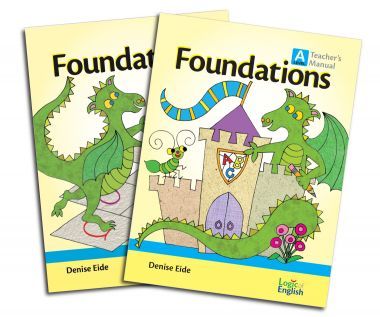
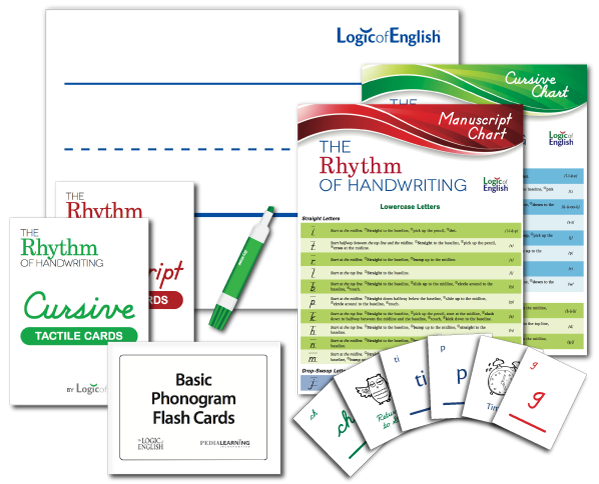
Thanks to the generosity of Logic of English, we received the following items for review:

                        Foundations, Level A – $71

    • Teacher’s Manual
    • Student Workbook
    • Doodling Dragons book

      Reusable Resources Set – $85
    • Basic Phonogram Flash Cards
    • 2 sets of Phonogram Game Cards
    • Manuscript Tactile Cards
    • Manuscript Handwriting Quick Reference
    • Half-Size Student Whiteboard

When we received our package, the Doodling Dragons book was the first thing to catch four year old Max’s eye.  Jensyn (my three year old) had to get in on the fun of this book, too.  It wasn’t long before my six year old had to join us, as well!   All three kids loved exploring the pictures in this book, and the silly sentences and phrases that accompany the pictures made them giggle!   (I won’t ruin the fun, but the page for the letter “U” is a favorite for all three children.)  I love how the book gently teaches letters and sounds, while still entertaining children.

loe2

I found myself a little overwhelmed at the thought of getting started with Foundations Level A.  It’s really quite simple, as it is laid out step by step in the teacher’s manual, but I got worked up at the thought of beginning with my four year old son.   Even though I believed he was ready, I was suddenly questioning if Max could do it.  At that point, he recognized uppercase letters, but hadn’t mastered lowercase letters.   It took a few days of staring at the beautiful stack of books to mentally prepare myself to get started with Max.

By the end of our first lesson, I knew this was a great fit for him!  First off, his high energy personality has met its match: Foundations Level A lessons are packed full of opportunities to wiggle!  Secondly, Max has some speech struggles, and the early lessons offer a great deal of practice in HOW sounds are made.  This was just perfect for him, as one of my fears for Max with phonics was that his pronunciation of sounds might affect his ability to pick up on basic phonics.  Logic of English Foundations Level A took away some of  my fears, as it teaches children hands-on ways to explore how the letter sounds are made.

We ‘popped’ our mouths as we made the /p/ sound, felt our throats buzz while making the /v/ sound, and blew out air as we made the/f/ sound.  My little tactile learner thought these activities were great fun, and he thought we were playing games rather than doing lessons!

Max loves the compound word activities where he’s blending two words to make one.  (I would slowly say “pop………corn”, and Max would shout out “POPCORN!”)  He begged for this game every day!  Circling the correct picture in the workbook was a great joy for him, too.  He truly enjoyed having his own, colorful workbook!

loe1

As for handwriting, Max has never written on lines before.  He has written adorable, wobbly letters across a piece of paper, but Logic of English Foundations Level A is his first experience with handwriting lines.   We found that the lines in the workbook were too small for Max, but he loves the giant writing lines on the white board.  We’ve ended up using this board for all of Max’s handwriting practice.  (I love the white board!  It’s super sturdy, has large handwriting lines on one side, and has smaller lines on the reverse side.  It’s a very well-loved, well-used board in our home!)

Logic of English handwriting does a great job of teaching the handwriting lines and the strokes needed to form letters.  I’m really impressed at how well Max is able to follow the handwriting lines to form letters that are correctly sized!

practicing his ‘swing stroke’DSCN1493

Review Lesson A (after Lesson 5) Handwriting Assessment

DSCN1495

To make the handwriting assessment more fun and multi-sensory, children are encouraged to add a block to a tower each time they correctly write a stroke in the handwriting review.  When the assessment is completed, the child gets to knock down their tower.  My energetic Maxwell thought this was great fun! 

contemplating where he’ll place the next block…DSCN1494

I tend to lean toward a more traditional handwriting approach, so I was a little skeptical of the handwriting style.  I must admit, though, that the Logic of English approach is very helpful for Max!  With the tactile letter cards (sandpaper feel) for tracing the letters, the learning of handwriting strokes in preparation for writing letters, and the way the handwriting is worked into the Foundations lessons, it all fits together so nicely.  Max is doing well with it, so we will continue with using these handwriting lessons!

Another lesson activity that my kinesthetic little learner truly enjoyed was found starting in Lesson 6, where I would slowly pronounce the sounds in common action words, then Max would shout out the word and act it out.   For example, I would slowly draw out the word as I spoke, saying /j-u-m-p/, and Max would have to mentally put together the sounds to recognize the word ‘jump’.   He would call out the word and then act it out.  He would have done this ALL DAY, I believe!  This is TERRIFIC practice for learning to blend words on his own as he begins to read!

We’ve used a stuffed animal to shoot baskets in a laundry basket, spun in circles, collected crackers, and done all sorts of other fun activities that leave Max feeling as if he is playing game rather than doing school work.  It really is a lot of fun for both Max and Mama!  (My six year old is more than a little jealous when I’m ‘doing school’ with Max!)

DSCN1492

DSCN1490
We’ve only completed the first ten lessons, although I look forward to working through all 40 lessons of Level A with Max.  As Max is still focusing on recognition of some lowercase letters, we are taking our time as we go through these lessons, just a bit each day and repeating as necessary.  I want to make sure he is SOLID in his letter recognition before we go too far, too fast and leave him frustrated.

Logic of English actually makes it easy to stretch out each lesson, as they provide SO MANY multi-sensory activities within the lessons!  We can write letters with sidewalk chalk, call out a letter sound, and Max can jump on the letter that matches the sound.  We can have a ‘g day’ where we learn about animals beginning with the letter g, eat foods that begin with g, make gifts for grandparents, and other g activities.  We can hunt for the letter d on signs, in books, or around the house.  We can write the letter a in a box of salt, drive a toy car in the shape of a handwriting stroke, etc.    I’ve already mentioned it more than once, but these hands-on elements really are perfect for a wiggly, young learner!

Even though we are going through this program at a fairly slow pace, I am noticing that Max is more attentive to letters in everyday life.  He is bringing up letter sounds in conversation.  He is beginning to recognize the letters and sounds all around him – and this is a big step in learning to read!

I look forward to some of the later lessons in the book, when we’ll get to use the little readers booklets in the back of the student workbook.  The animal photographs in these books are so cute, and I know that Max will love them! 

All pictures in this post were taken during Review Lesson A.  I’m usually really good about getting pictures during our school work, but Foundations A is such a hands-on program that I’ve been forgetting all about the camera and just focusing on having fun with my boy!  I finally grabbed the camera during the Review Lesson to snap some pictures for this review…and then promptly returned to NOT taking pictures so I could just enjoy the fun of LOE with Max!

If you are looking for a playful, yet very thorough, way to introduce your child to phonics and handwriting, you will definitely want to take a close look at Logic of English Foundations Level A!  To read more reviewers opinions of Logic of English, please click on the graphic below:

Click to read Crew Reviews

Crew Disclaimer